
a regular decorated emergency
self-injury and bodily autonomy in house md

Nothing feels injurious anymore. Remember when you could turn on your TV and watch sweaty men beat each other to a pulp in a complicated approximation of hurting themselves, and how for the next 6 years everyone made jokes about how the first rule of fight club was that you don’t talk about fight club? Even though that movie was fairly brutal about its argument in relation to (self-)injury being a gendered response to the flattened affective terrain and urban alienation at the end of the 20th century?
It feels to me like mentions of suicide and self-injury used to be all the rage. I might also just be in a bubble of my own taste but you can’t deny that there does exist a specific genre of 2000s indie movies in the vein of The Catcher in the Rye – like Igby Goes Down and Wonder Boys – that had suicide and/or self-injury at their core, a genealogy which I’d argue ended commercially with The Perks of Being a Wallflower. This is all tangential, but it does graze at my larger point. Suicide and self-injury used to exist much more prominently in the cultural consciousness, from my methodical and in-depth study on the subject, and they seem to have faded out in favour of shiny surfaces and second screen1 scripts which always hold their dumb, dozing viewer at arm’s length. It’s more likely you wouldn’t be invested enough to care that a character was thinking about harming themselves, not in any real way. And that isn’t even necessarily all the fault of the viewer, but also down to the quality of the writing and the assumptions made on the part of the executives about what they think people want to see. i have more to say on surfaces which i’ll save for a different moment, but it’s a little disarming, i think, to realise that these deeply troubling discourses have ‘disappeared’.
Obviously they haven’t, not entirely. Things don’t go away because we’ve stopped representing them. Where they’ve gone I don’t know. Perhaps they’ve simply retreated, with the rise of irony and cynicism as the new characteristics of the form. But at one point, they were everywhere, including on the utterly insane hospital drama, House MD, which aired during the phase of 2000s TV where (for some reason) everything was a procedural. Often, the episodes followed a formula, always starting with a patient experiencing a mysterious ailment and being brought to House’s diagnostics department. Rushing against time, House and his devout ducklings (a team of about 3-4, varying across seasons) race against the clock to save the patient’s life, usually involving some felony in pursuit of the Information that will Save A Life. Eventually, they do, everyone’s somewhat pleased, and while they wind down House pops a pill and stares vacantly into the distance. His leg hurts.
I’d argue that in the case of House, though, the detective paradigm presented interesting and complex implications about the body and its purpose in the hospital as an institution. The procedural formula presented the implication that the body could be (re)solved, but this always came up against its encroaching reality, which was hammered in every episode via House’s chronic pain and his addiction to Vicodin. Even as he wields his unparalleled intelligence, he’s always debased by his body and its complaints, summarised succinctly by the early-season line: “God doesn’t limp” (3x02). Against this debasement, though, i think this show exists in the same vein as Fight Club; absorbed unthinkingly into the common consciousness for references and Super Bowl ads, easy commodification flattens the more troubling elements of both texts.
In watching House, what i think lends the show its edge is this thorough argument about bodily autonomy – obviously brought to the forefront in the provocative setting of the hospital – in that being truly respectful of bodily autonomy means respecting people’s choices to do what they want with their bodies, even when you might perceive that behaviour to be bad or antithetical to living. Particularly from seasons 6 to 8 of House, the show insists that there is some dignity and liberation to be found in being the one to destroy yourself, even if it’s impossible for others to understand. Instead, it might be even better that the people in your life don’t understand, as it precludes the kind of legibility and resolution that might otherwise give rise to pity. It’s no wonder House is portrayed as such a snarling, snarky character. Everything he does is against poised legibility, from weaving an elusive story out of the operation that destroyed his life (1x21), to generally being enough of an unpleasant person if only so no one would have the nerve to pity him for his handicap.
For the most part, the show establishes his attitude towards his body through the undercurrent of addiction. Initially, it’s handled with a lightness that crescendos in moments (especially in Season 1, with the crescendo in his first short-lived attempt at sobriety in 1x11) but its only in Season 3, deep in the throes of his involuntary sobriety that the interlinking between pain, addiction, and self-destruction in House’s character are synthesised enough to be more than just a character quirk. Specifically, there’s an episode in Season 3 which clearly establishes that the chronic pain has created a space for addiction in House, because he needs something external with which to manage the pain. Vicodin, as a painkiller, performs two functions: it numbs his constant pain, and is an addictive substance. So it makes sense that in the absence of Vicodin, House is not above causing himself more pain to wipe out the first, going as far as cutting himself to manage it (3x10).
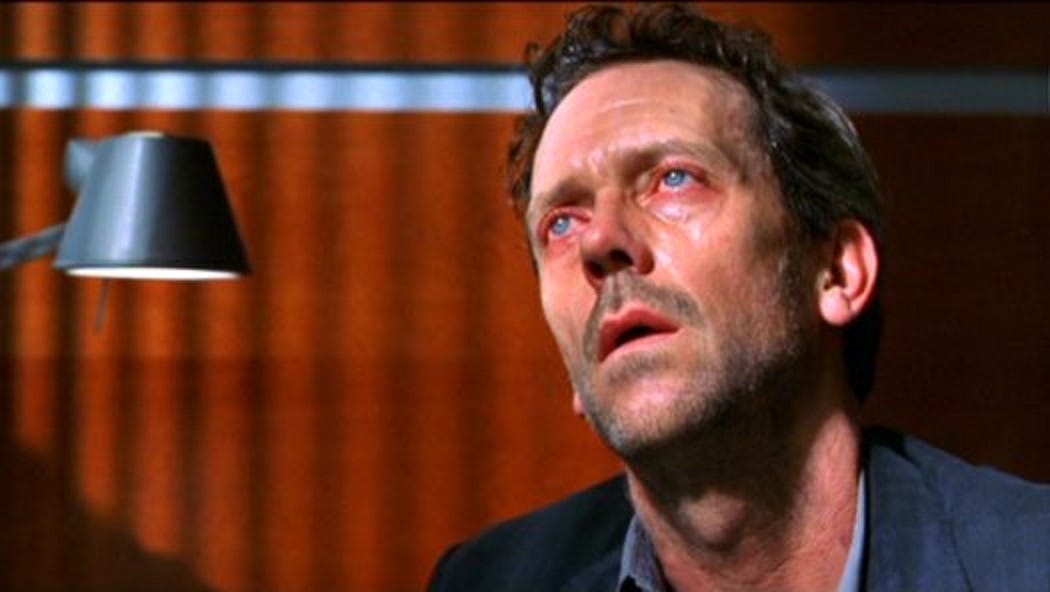
What’s at stake here is that he does it to himself. He’s a character with a lot of ego, and that comes across in every single decision he makes to raise a hand against himself, instead of going under someone else’s knife. While Season 3 establishes this as a paradigm of his behaviour, it’s not till the diptych finale of Season 7 that this is hammered home, with the glorious suicidality of someone in complete free fall.
Season 7 is kind of a weird one, in the way that all transitional periods are. House ends up disproving a lot of the assumptions he’d held about himself previously as an addict and a womanizer, from his sobriety to being in a serious, fairly long-term relationship for the first time in 5 years. It is, to be entirely honest, too much change to handle. They’re all positive changes, but when you’ve been twisted up tight in your own world of pain for that long, even the good can feel enough like a threat for you to consider blowing up your life all over again. Even if it’s only because it feels familiar. So he blows up his relationship, tries to blow up a friendship, and then flirts with his own obliteration by dosing himself with a drug that hasn’t proceeded to clinical trials just yet. The drug is meant to aid muscle regrowth, which he sees as a solution to his damaged leg. Unfortunately, all it ends up doing is spawning a field of tumours in said leg, creating the circumstances upon which Season 7 closes – with House, shivering and bleeding and alone in his bathtub, performing surgery on himself.
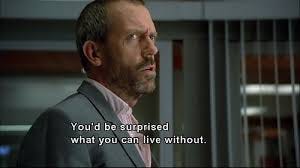
The episode that follows is nothing short of a reckoning. Having finally worked up enough self-preservation to call his ex-and-also-head-of-hospital Dr. Cuddy, House is brought into emergency surgery to save whatever’s left of his leg. He emerges with his leg still intact, still in pain, and everyone in his life absolutely furious at him. Partially, this is due to the stupidity of his actions. The more uncomfortable element is that no one really knows what to make of this. No stable meaning can be drawn out from a self-destruction House refuses to talk about, let alone allow anyone to reconcile it with what they know of his character. He’ll say, “I was self-destructive. It won’t happen again.”, but that’s about as much as we get.
In a decision that was extremely satisfying to my exact constellation of interests, the writers created twin storylines for this episode. House’s recovery from self-inflicted injury is placed alongside the spectac-ular self-destruction of a performance artist who is a very obvious iteration of Marina Abramović, performing a very obvious iteration of her piece, Rhythm 02. As she falls victim to a mysterious ailment during her performance, she slides into House’s orbit.
The only real element of the plot you have to know is that not-Marina Abramović is in complete control of whatever’s plaguing her the whole time, and has designed it as a puzzle that only House can solve. Their twin tracks intertwine in this way – while she might otherwise believe that “explaining her work limits its potential”, she is willing to be made legible only if the person on the other end of that dynamic is, themselves, wrapped up in their own instinct towards illegibility. Similarly, House cannot see outside himself (pain is repeatedly brought up as world-collapsing for him) but is willing to perform the task of making-legible for others. Not that it helps to understand why your body is failing you, but more often than not, legibility offers a cure to his patients in a way it does not for him. As is hammered home by this episode, the thrill of chasing the narrative connections between symptoms is all he feels he can do.
The episode gets most interesting when it tries to interrogate the imposition of meaning as another way bodily autonomy is violated by others. Not-Abramović’s assistant, Luca, is constantly asking, “Does this mean something?”. The artist believes her work has “potential”, that its meaning may not be inherent but lies somewhere between herself and an interfacing with the audience. House, on the other hand, is growing increasingly disgusted and much less willing to play along. His low views of performance art aside, it becomes obvious as the episode proceeds that both House and the artist have become entangled in the other’s trajectory towards self-destruction. Sickened by this recognition, House lashes out: “I don’t think your piece is about anything. I think you just figured out that you’re mortal. You’re just a bag of cells and waste with an expiration date. You wanted to act out, you wanted people to notice. Maybe you even prayed for a different answer this time. I got a title for your piece – It Doesn’t Mean Anything.”3
Following this, the rest of the episode follows House insisting on remaining elusive and illegible – even though, following the hospital paradigm, we know that illegibility can spell certain death. For House, however, the imposition of meaning and the well-meaning sympathy of others is an affront to his own state of being. As he faces personal reckonings in the form of Drs. Wilson and Cuddy, he’s always turning his face away, and refusing them. As Wilson confronts him about his misery, for example, he petulantly says: “You want to know what I feel right now? I don’t feel miserable, or angry. I don’t feel good, or bad. I feel nothing…which feels great.” With Cuddy, he delivers a tirade of pain worthy of Bob Flanagan: “I did it to fix my life. No, wait. No, I did it because I’m a deeply unhappy person – no, I did it to get sympathy from you. I did it to piss you off. I did it because I’m not over you. Or I was over you, and I was moving on. I did it because I wanted to know what it was like not to be in pain. I did it because I want to feel more pain.”
There comes a point with trying to explain self-destruction that you realise there is no logic in the world that can make it cohere, or occupy a stable plane of meaning. Just as House finds that he and the artist share a dogged intent towards self-destruction, which has manifested in the artist choosing to die (to which House responds: “Good for you.”), she does the unthinkable: she changes her mind. For House, of course, this upsets him more than anything, having only just arrived in a place where his self-destruction seemed almost signed off on, permitted. And now, with the artist embracing the decision to fight, to be cured, House feels more alone than ever.
The conclusion the episode finally arrives at is an uncomfortable one, and, from what i understand, widely hated by many a fan of the show. It’s horrible, and a total encroachment upon the boundaries of another human being, but for House, the conclusion of this episode (and for that matter, the finale of the entire show) is an inevitable leap into complete oblivion, with no interest whatsoever in stopping it. While the implications of that can be upsetting, especially with regards to living with chronic pain, i’m generally suspicious of anything that puts too much faith in expression or alleviation. It’s much more truthful, i think, to leave these things unpleasant and unresolved4. The tension is what lasts5.
thanks for reading! as you can see, we’re back to regular programming around here. at the same time, i’ve also had this blog(??) for going on 4 years now (!) so i felt it was time for a change — you can now find me at projectiondept.substack.com, retiring from opengravetheory. i might put out a “manifesto” (lol) of sorts about that at some point because i love reading statements of intent and creating thematic coherence but..we will see…thanks for sticking around and i’ll see you when i see you !
“Such slipshod filmmaking works for the streaming model, since audiences at home are often barely paying attention. Several screenwriters who’ve worked for the streamer told me a common note from company executives is “have this character announce what they’re doing so that viewers who have this program on in the background can follow along.”” Excerpt from Casual Viewing by Will Tavlin, in n+1.
Rhythm 0 was Abramović’s 1974 performance piece, in which she stood in the centre of a room, and 72 objects were laid out on a table before her. The audience/visitors, standing in the same space (no delineations) were invited to “use [the objects] on [Abramović] as desired”, as part of a “Performance. I am the object... During this period I take full responsibility.”
in case you were curious, i’ve written before about the instability and refusal of meaning via self-destruction here
just as a note, i think the most radical book i’ve read re: respecting other people’s rights to do ‘bad’ things to themselves is Yiyun Li’s Things In Nature Merely Grow. initially i was going to write about that, but i think you’re much better off reading her directly, because she puts forth incredibly clarifying arguments on self-destruction/suicide/activities fundamentally antithetical to living.
cover image is Man in Blue by Francis Bacon.
Ra Projectiondept Reveals The Meaning btw
Haven't made it to s7 yet but exciting to reflect my viewing through this lens! Another delicious read, thank you :))