
solitary confinement
reading celia paul

i’ve had yet another drought of inspiration recently. my listlessness has led me to borrowing magazines from the library, flicking through them at breakfast in the hopes that something will strike me. occasionally, some bit of light will break through: like this great piece about the absent presence of the hospital in the grotesque figures of egon schiele, and, more recently, this careful study of celia paul’s work in the lrb. i was less taken by the analysis of her work than the work itself. i couldn’t believe i’d never come across her paintings before, when she paints light and the world exactly as i hope to see it.
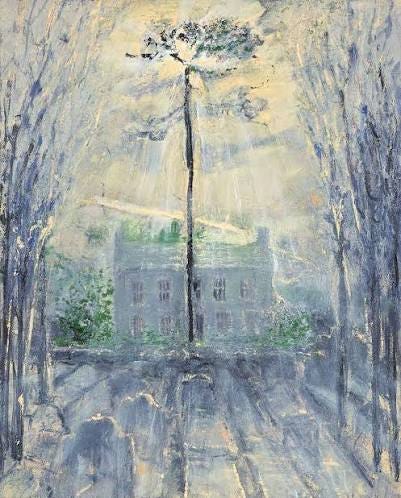
Paul’s work and her attentiveness to it has really stuck with me. i’ve been on a kick reading furiously about her this last week, in her own words. self-portrait, her memoir first, and now the thick volume of her letters to Gwen John. the larger strokes of her life have been revisited again and again; they are mostly of her time in London as a student at The Slade, where she met Lucian Freud and entered a decade-long love affair with him. from the article, i do think there is a tendency to make too much of this. she thinks so too. the terminology of “artist in her own right” provokes her distaste in one of her letters to Gwen John. i admired that. the pain she experienced, of the waiting and the rejection and the neither-here-nor-there of that relationship, is only interesting insofar as it allows her to make something true in the work.
in one of her letters, Paul writes:
“What interests us is the spirit world, our inner world. Our instincts may be maternal or daughterly, but our deepest desire is for our art. Your aim, always, was to lead a more and more interior life.”
this is not to say that she rejected life. her later paintings, done from her flat overlooking the British Museum and the neon spire of the BT Tower, include these implements of modern life which could be construed as invasions to this mysterious inner landscape. (i was shocked to realise that in my time living in London and making my same sad pilgrimage, i must’ve walked past her flat a hundred times.) her other paintings are of her husband, her son, her sisters, and most recurrently, her mother. when you see how she paints them, you get the sense that it is exactly the presence of these people in her life that allows her access to the inner world she speaks of, or at least to communicate that access in the medium of paint. the paintings, feel to me to be what Marie Howe describes in The Affliction as “a third place I’d not yet been”, constructed in the application of paint and guided by that innermost sense of what must be created.
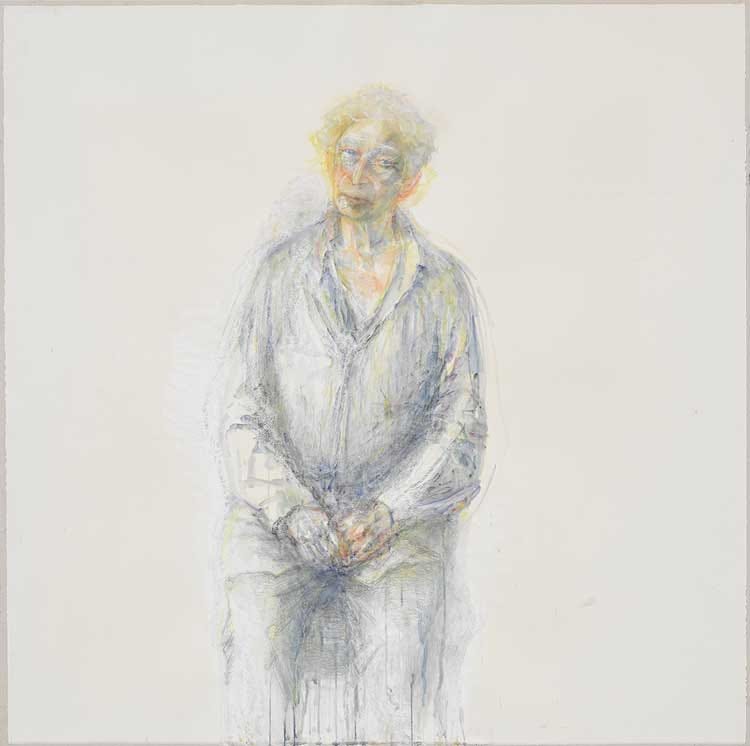
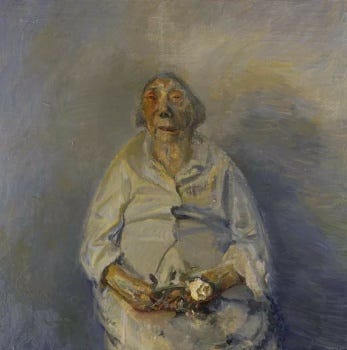
the palette of these pictures, made later in life, are softer than the black and deep browns that inform her paintings of the 80s and 90s. her earlier family portraits are cast in shadow. the windows are not yet open enough to let the light in, and you get much more of a sense of confinement. it’s extraordinarily difficult to want to protect yourself from pain and to express that pain at the same time, to make it good1. what is interesting to watch is that gradual entry of light until the whole thing is suffused with the soft blue of the pictures i’ve included. Paul considers her best work to be the painting My Mother and God, which depicts her mother’s sitting figure in the foreground, subsumed by a wall of black and brown which is as alive and essential as any of Rothko’s colour field works.
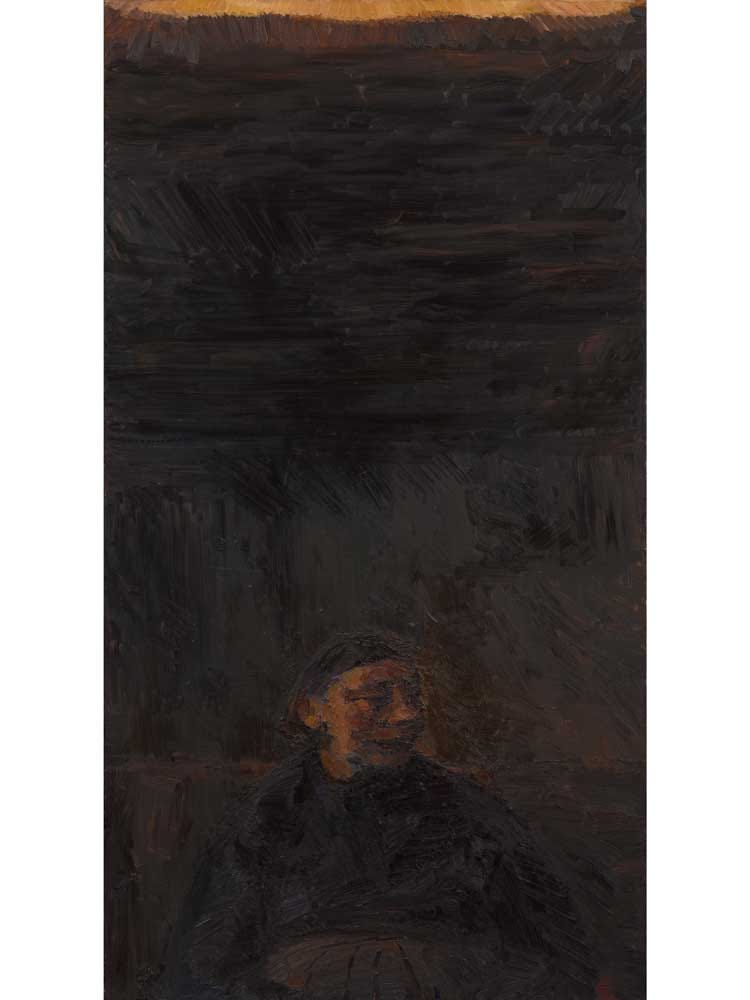
in her letter to Gwen John, Paul draws particular focus to the band of gold at the top of the painting, which she describes as the proverbial “light at the end of the tunnel”, following the “dark night of the soul”. the suggestion is that this is also where god is found, as much as in the weight of the dark. after the pain has finished with you, and after you have finished with the pain, something else can be synthesised and thus revealed. the form it will take begins as a band of light. i like to think of her later works - so many of which include big, open natural spaces, filled with a pale blue light - as the expansion of this thin band. Paul herself isn’t religious, and neither am i. what i mean when i say god is what i often say is the relation to other people and the world itself, all of which must first pass through you.
i’ve found myself writing again. i am not sure what it will become yet, if anything, but it’s been immensely comforting to be in the presence of someone who speaks so respectfully of their own inner world. people, sometimes including myself, can get shameful and self-conscious about it, but i find that imposition does a great violence to ourselves because it seems to rob us of our dignity. why should we not protect that fiercely? i’m often reassured by the fact that regardless of how my life appears to others, i know i’m doing exactly what i’m supposed to. i’ve been lucky enough to live with a great sense of guidance. even when it has led me to great pain and endless tears, i know it is all an immitigable threshold i must pass through. i don’t know that it’s anything so dramatic as the “dark night of the soul” that Paul makes reference to in a letter to Gwen John. to follow both her restraint and candour, it’s a “necessary passage”. i know where i’m going, anyway.
to be clear, i mean to make the work good, not the pain. the pain is just pain unless you make something of it.
❤️🔥🤍🪽
please never stop writing