
visions of hell
ken russell's mahler (1974)

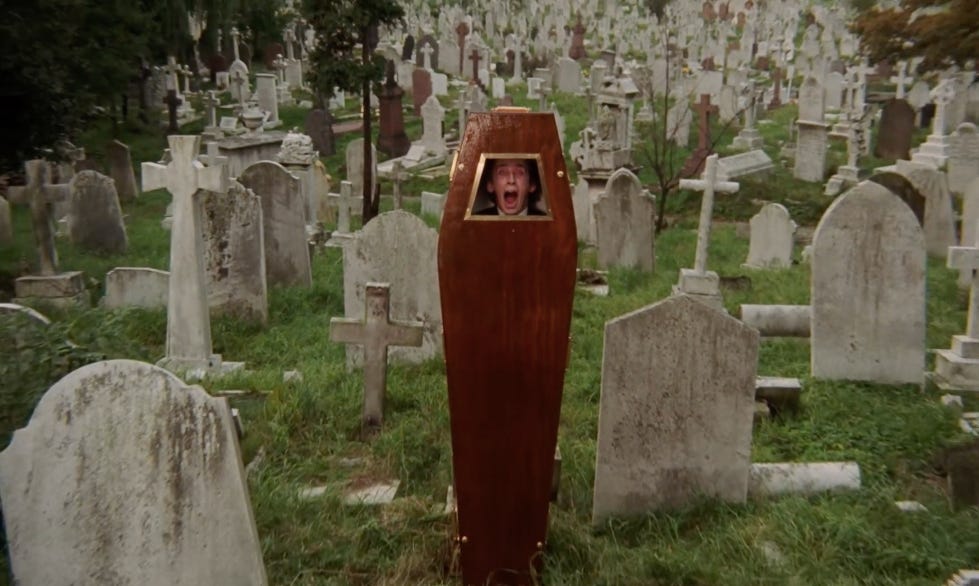
the titular character of Ken Russell’s Mahler (1974), like many great geniuses committed to the screen, is not granted the ability to live. beset by a fatal bout of subacute bacterial endocarditis1, he endures a purgatorial train ride through the landscape of his life which is marked by a combination of irreconcilable shame and transcendent beauty. it’s what you’d expect out of most lives. what severs him from ordinary life, however, is that he’s not granted the ability to die either. calling to mind Hamlet’s woeful description of unfortunate men “crawling between heaven and earth”, Mahler is left squirming in his sickly body, plagued endlessly by dreams and visions which entomb him in the tension between creating (as in composing) and conducting (as in conducting). it’s hard to be a vessel.
Mahler’s been preoccupying me the last few months. the problem i’ve had is with saying why. of course, the film contains a lot of what i love: insane classical music, a home on fire, feverish visions, all whilst teetering on the threshold between life and death. i don’t have much of a tendency for the expressionistic, though, and having only seen Russell’s The Devils, i am far from having mastered the vocabulary of this form. lacking the vocabulary is however, fun because it means: 1) i get to learn new vocabulary and 2) it’s actually, strangely, apt for this film because the way it presents its purgatorial paradigm gives it a relentless focus on the points of life (and, inversely, death) at which conventional articulation fails entirely. to quote Mahler: “My music begins where words leave off”. or, as my good friend and co-conspirator Nico remarked: “there’s no conceivable way i would want to translate this into words”.
i’ve tried to write this piece repeatedly, i’ve combed over and over it again but i have found nothing to answer the question: what happens when representation – in art, its expression - fails? one answer, when it comes to the novel, is that we might feel some satisfaction in telling this failure2. Ken Russell certainly did; despite being regarded with some horror after The Devils, Mahler is now considered among critics to be one of his best, if not the best of his films. but what of Mahler, himself? maybe it is myopic to insist on the historically inaccurate universe that the film creates – drawing vitriol from critics at the time, who were incensed at Nazi iconography being used in a scene supposedly set in 1911 – but these nightmarish visions of hell and an incomplete life which become increasingly gouged out from ‘reality’ still have something to tell us, i think.
from the outset, Mahler’s dream is to be assimilated into an institution which could ostensibly provide him a way out of antisemitic discrimination, and into truth, beauty, and perhaps most crucially, worthiness. this is expressed consistently in the film’s nonlinear mode, as it flicks back and forth between childhood and the terror of the train ride. moving between idyllic memories and the encroachment of his sickly body, they’re exaggerated variations on the real, but their form doesn’t seem to suggest that they require anything more to be adequately communicated on the screen, or in music.
as the film chugs on through his adult life, though, we see that conventional representation of this sort begins to fail. the horror of being trapped in a sickly body, and still trying your hardest to prove your worth against a systemic discrimination that refuses to hear otherwise is one that is beyond any sort of depiction. there are moments like this which emerge, where the reality of what’s being experienced in your body will never, ever find true expression in life. the nightmare scenes he experiences is only representative of the chasm that has opened between his reality and the world.
cover image is eyes on the table by remedios varo (1938).
from alex ross, the rest is noise: listening to the 20th century.
paraphrasing Jameson: “for Lukács the most basic image of human freedom is not the hero of the novel, for he can never succeed in his quest for ultimate meaning, but rather the novelist himself, who in telling the story of failure succeeds — whose very creation stands as that momentary reconciliation of matter and spirit toward which his hero strives in vain.” as found in this very cool article on Sally Rooney lol
your writing ... always so delicious
CO CONSPIRATOR CITATION DONT JOKE ................ it's really a beautiful way to reckon and contend with the problem of an expansive legacy that is already bursting out of the life that contains it... !!!!!